







In this guide
Yes, seaweed is good for dogs when it is plain, dried and fed in small amounts. It adds iodine, minerals and fibre to the bowl, and one brown seaweed, Ascophyllum nodosum, has a dog trial behind it for plaque, tartar and bad breath. Most of the other benefits you read about come from lab work rather than from dogs, and we show which is which below.
Seaweed is bad for dogs in three cases. Dried seaweed picked up on the beach can swell in the gut and block it, so that is a vet visit straight away. Seaweed snacks made for people are often salted or flavoured with garlic and onion. And too much iodine harms the thyroid, which is why a dog with a thyroid condition needs the vet's OK first. If you only want the quick yes or no, our short page on whether dogs can eat seaweed has it.

Is seaweed good for dogs?
Seaweed is a sea vegetable. It has no roots to feed it, so it takes minerals straight from seawater. That makes it high in iodine, and it also contains calcium, magnesium, iron, zinc and other trace minerals. It has fibres that a dog can't digest on its own, such as alginate, fucoidan and laminarin in the brown seaweeds and carrageenan in the red ones. These reach the large gut intact and the gut bacteria ferment them, which is why seaweed is called a prebiotic (de Jesus Raposo and colleagues, 2016, Marine Drugs).
What that does for a dog depends on the benefit. Some have a proper dog trial behind them, some only cell or rodent studies.
| What seaweed is said to do | What is behind it | Evidence in dogs |
|---|---|---|
| Cuts plaque, tartar and bad breath | A 90-day double-blind trial in 60 dogs fed Ascophyllum nodosum (Gawor 2018) | Good. One well-run trial, paid for by the maker of the product tested |
| Supplies iodine for the thyroid | Iodine is an essential nutrient, and complete dog foods already contain it | Real, but a dog on complete food rarely needs more |
| Feeds gut bacteria and firms stools | The fibre ferments in the gut. In 10 healthy dogs, four seaweeds changed nothing measurable (Pinna 2021) | Weak so far |
| Healthier skin and a shinier coat | Zinc and iodine both matter for skin and hair. Six of the 40 published reviews of our Irish Kelp mention coat | Owner reports only, no controlled trial |
| Less inflammation, easier joints, fewer allergies | Fucoidan, a brown seaweed fibre, calms inflammation in cell and animal studies (reviewed by Fitton, 2011) | Lab only. Not a treatment for arthritis or allergies |
| Protection against cancer | Cell studies with purified extracts | None in dogs, and we don't claim it |
So seaweed is good for dogs as a food and for the teeth, and it may help the coat. The joint and cancer claims printed on many labels go well past anything shown in dogs.

Gut health is where the marketing runs furthest ahead of the evidence. In a study by Pinna and colleagues (2021, Animals), 10 healthy adult dogs ate a set diet alone and then with each of four whole seaweeds (Ascophyllum nodosum, wakame, a kombu kelp and dulse) at 15 g per kg of food, for 28 days at a time. Their stools, gut bacteria, gut antibodies and digestion did not change. In 14 dogs with chronic gut inflammation, a diet with 4% Ascophyllum nodosum shifted some gut bacteria and fermentation products but did not improve the dogs' symptom scores (Isidori and colleagues, 2021, Animals).
Seaweed fibre is fine to feed. It just isn't a proven fix for loose stools, and a dog with diarrhoea that keeps coming back needs a vet.

Coat comes up in reviews of our Irish Kelp. Six of its 40 published reviews talk about coat, fur or hair (Judge.me, read 7 November 2026). Mandy D. wrote on 21 April 2023, "Tried various things to improve my dogs coat. 2.5 months in and her coat is glossy, thicker and darker." Not everyone sees it. Carole gave it one star on 2 April 2023 and wrote "no noticeable difference on my dog".
A dull coat or itchy skin often has a cause that no supplement will touch, such as fleas, a food allergy or a hormone problem. Get that checked by your vet before you put it down to diet.

Seaweed for dogs' teeth
Teeth are where seaweed has real dog evidence. In a double-blind, placebo-controlled trial of 60 small-breed dogs (Gawor and colleagues, 2018, Frontiers in Veterinary Science), every dog first had its teeth cleaned under anaesthetic. Then half got daily treats containing Ascophyllum nodosum and half got the same treats without it, for 90 days. By day 90 the seaweed group had about 38% less plaque and about 20% less tartar than the placebo group. Tartar, also called calculus, is plaque that has hardened. The seaweed group also had 46% less of the sulphur gases that make breath smell, and their gums bled less.
Breath was no different at day 30, so expect weeks of daily feeding, not days. The trial was paid for by the company that makes the treats tested. The VOHC, the US council that gives its seal to dental products that pass its tests, lists an Ascophyllum nodosum powder for dogs as accepted for plaque and tartar.
That is why Canident is made from Ascophyllum nodosum and nothing else. The seaweed is harvested on the west coast of Ireland, and we make Canident in County Wicklow, where we also pack and label every tub. Our guide to knotted wrack and the science behind it covers the species in more depth.

Anna wrote on 26 January 2026, "One of them definitely has sweeter breath and cleaner teeth now. The other started with much worse breath and tartar build up and I think she will need a little more time." Her two dogs show the same thing as the trial. Change takes weeks, and a mouth with more tartar takes longer.
Seaweed won't shift tartar that has gone brown and hard below the gumline. That needs a scale and polish at the vet. Bleeding gums, a loose or broken tooth, a swollen face or a dog that stops eating are vet visits too. Canident has a 15-week money-back guarantee. If it hasn't worked after 15 weeks of daily use, send us your order number and before and after photos and we refund you.

Iodine and your dog's thyroid
Iodine is the reason seaweed needs a measured dose. Dogs need a little of it to make thyroid hormones. Seaweed holds a lot, and the amount swings widely between species and even between batches. When Teas and colleagues (2004, Thyroid) tested 12 edible seaweeds, iodine ran from 16 micrograms per gram in nori to over 8,000 micrograms per gram in kelp granules made from Laminaria digitata.
One gram of that kelp holds about 8 mg of iodine. EU feed law recommends no more than 4 mg of iodine in a whole kilogram of complete dog food (Regulation (EU) 2015/861). That single gram carries twice as much.

Too much iodine can slow the thyroid down. In a study by Castillo and colleagues (2001, The Veterinary Journal, 18 dogs), puppies fed a commercial diet high in iodine, or a home-made diet with the same amount of iodine added, made less thyroid hormone and developed hypothyroidism, an underactive thyroid. So we never suggest kelp as a home fix for a dog you think has a low thyroid. A low thyroid needs a blood test and, if it is confirmed, treatment from your vet.
Ask your vet before giving any seaweed if your dog
has hyperthyroidism, a thyroid tumour or any other thyroid diagnosis
takes thyroid medication
has kidney disease
is pregnant or feeding puppies
is on other long-term medication
Our Irish Kelp product page says the same. It is not recommended for animals with any thyroid issues, because it is a natural source of iodine. If your dog is on seaweed and you notice a change in weight, thirst, energy or coat, stop it and see your vet. Our page on how much iodine dogs need goes into the numbers.
Seaweed species for dogs
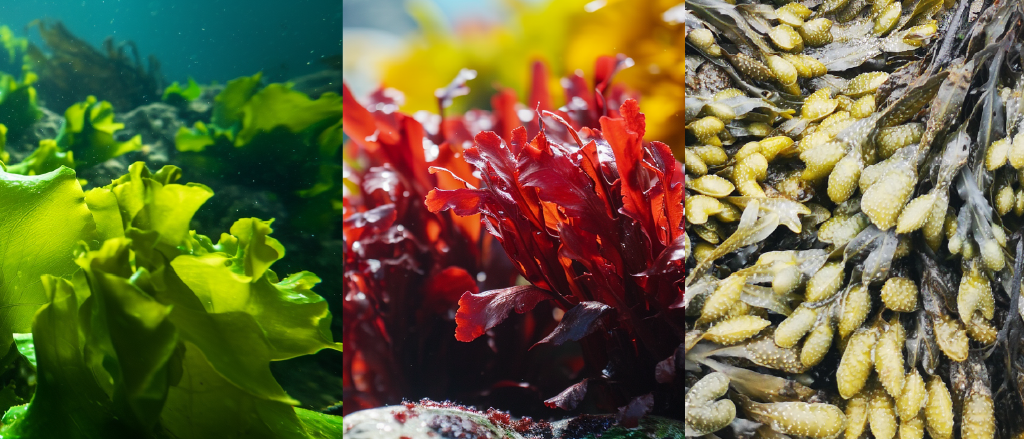
Seaweeds fall into three colour groups. The brown ones, kelps and wracks, are the most used for dogs and are the richest in iodine. Red seaweeds include dulse, Irish moss and nori. Green seaweeds include sea lettuce. For a dog, the species matters more than the colour, and our page on why the seaweed species matters explains the differences between brown seaweed and kelp.
Ascophyllum nodosum (knotted wrack)

Ascophyllum nodosum grows on sheltered rocks between the tides along the North Atlantic, including the west of Ireland. Its long olive fronds carry single egg-shaped air bladders, one after another, which gives it the name knotted wrack. It is sometimes sold as rockweed or Norwegian kelp, although it is a wrack rather than a true kelp.
It is the species in the dental trial above and the only seaweed in Canident. Like every brown seaweed it carries iodine, so it is dosed with the scoop on the pack.
Fucus vesiculosus (bladderwrack)

Bladderwrack is the wrack most people know, with round air bladders in pairs either side of a central rib. It has a long history as an iodine source and turns up in many kelp blends for pets. The same iodine rules apply as for any brown seaweed.

Fucus serratus (serrated wrack)

Serrated wrack, also called toothed wrack, has saw-toothed edges and no air bladders. It grows lower on the shore than bladderwrack and is common on Irish and British coasts. For a dog it is fed and dosed the same way as bladderwrack.
Laminaria digitata and sugar kelp

Laminaria digitata, or oarweed, is a true kelp. It grows just below the low-tide line, with wide blades split into fingers. It was the highest-iodine seaweed in the Teas study, so it only belongs in a dog's bowl as a small, measured part of a blend, never as a spoonful of its own.
Saccharina latissima, sugar kelp, is a close relative, named for its sweet taste, which comes from a sugar alcohol called mannitol. It is grown on seaweed farms in Europe. As a kelp it is high in iodine, so treat it with the same caution.
Palmaria palmata (dulse)
Dulse is the red seaweed people in Ireland have eaten as a snack for centuries. Plain dried dulse is fine for dogs in small amounts. It was one of the four seaweeds fed in the Pinna study, and the dogs stayed healthy throughout. Skip dulse that is salted, smoked or flavoured.
Chondrus crispus (Irish moss, sold as sea moss)

Chondrus crispus is a small, fan-shaped red seaweed of North Atlantic rocks, known in Ireland as carrageen or Irish moss. It is the original source of carrageenan, the gel used to thicken food. Sea moss gels and powders sold for people are made from it or from other red seaweeds, and the label doesn't always say which.
Plain sea moss in a small amount is fine for most dogs. Check the ingredients on the jar first, because many gels have fruit, sweeteners or flavourings added. Xylitol, a sweetener, is poisonous to dogs. The iodine in sea moss varies too, so the thyroid rules above still apply.
Ulva (sea lettuce and gutweed)

Sea lettuce is Ulva lactuca, a thin bright green sheet. Gutweed is Ulva intestinalis, a different species made of hollow green tubes, once called Enteromorpha. Both are eaten by people. There is little dog research on either, so plain dried flakes in small amounts are the most we would give. Don't let your dog graze them off the rocks, for the same reasons as any beach seaweed.
Nori
Nori is the red seaweed pressed into sheets for sushi. It had the least iodine of the seaweeds Teas tested. Plain, unseasoned sheets torn into small pieces make good dog treats. Snack sheets with salt, soy sauce, sesame oil or garlic do not.
When seaweed is bad for dogs
Beach seaweed is the dangerous kind. On a warm day seaweed dries and shrinks on the sand. A dog that swallows it takes in water and the seaweed swells again inside the intestines, where it can cause a blockage. Wild seaweed also carries a lot of salt, which can make a dog very ill, and it can hide sand, shells and small creatures.
If your dog has eaten seaweed on the beach, ring your vet straight away. Don't wait for signs. Vomiting, diarrhoea, not eating, tiredness and weakness can follow, and a blockage can get worse within hours. Our page on beach dangers for dogs covers what to watch for on a walk.

Seaweed made for humans is the second trap. Seaweed snacks, salads and sushi are often seasoned with salt, soy sauce, garlic or onion. Garlic and onion damage a dog's red blood cells, and sushi with raw fish is not a dog food either. Only give seaweed that is plain.
Avoid hijiki altogether. The UK's Food Standards Agency advised people not to eat it in 2004, and again in 2010, because its survey found inorganic arsenic in the hijiki samples. The arame, kombu, nori and wakame in the same survey showed none.
The last risk is simply too much, from a heavy hand with the scoop or from two seaweed products at once.
Where the seaweed comes from

Seaweed takes up whatever is in the water around it. That includes iodine and minerals, but also heavy metals such as inorganic arsenic, cadmium and lead. Where a seaweed grows, and whether each batch is tested, matters more than the name on the tub. Excess iodine and arsenic are the two main risks of eating seaweed (Cherry and colleagues, 2019, Nutrition Reviews). Any seller should be able to show you a certificate of analysis for heavy metals and iodine.
Wild seaweed should also be cut so that the beds grow back. Wild or farmed makes little difference to the dog, as long as the water is clean.

Canident and Irish Kelp both use seaweed from the west coast of Ireland. Irish Kelp for Pets is a blend of three brown seaweeds from the wrack family (Fucaceae) and the kelp family (Laminariaceae). It is dried at low temperature in a dehumidifier room, then milled fine so it mixes through food. Canident is Ascophyllum nodosum alone.

How much seaweed to give a dog
For plain seaweed from the shop, such as nori or dulse, a small torn piece or a pinch on the food is enough. For a supplement, follow the scoop on the pack. This is the dose on our Irish Kelp, which comes with a 2 g scoop.
| Dog's weight | Irish Kelp for Pets, once a day |
|---|---|
| Under 10 kg | 1 scoop |
| 10 to 20 kg | 1.5 scoops |
| Over 20 kg | 2 scoops |
Canident is dosed by weight too, at half to one 2 g scoop per 10 kg of body weight once a day, so a 20 kg dog gets 1 to 2 scoops. Once the teeth have improved, it can drop to half that for maintenance. With either product, start with a pinch and work up to the full amount over several days. If you use more than one seaweed product, keep the total seaweed under 5% of the dog's food, which is the limit on the Irish Kelp product page.

The fibre can soften stools in the first weeks. Wendy M. wrote on 19 July 2026 that "her stools are softer but even so early on her breath doesn't seem quite so bad". If that happens, drop back to a smaller amount and build up more slowly. The trial fed it every day, and that is how we suggest giving it.
Between 1 January 2025 and 6 November 2026, 316 customers bought Irish Kelp from us across 456 orders, and 77 of them, about one in four, came back and ordered it again (our Shopify orders, cancelled and test orders excluded).
When it's a vet question, not a seaweed question
Seaweed is a food and a supplement. It doesn't replace a diagnosis. See your vet, rather than reaching for a tub, if your dog
has eaten seaweed on the beach, or is vomiting, has diarrhoea or has stopped eating after a beach walk
has a thyroid diagnosis, takes thyroid medication or shows a change in weight, thirst or energy
is limping, stiff or in pain, because joint problems need a diagnosis before any supplement
is itching, losing hair or has sore skin
has bleeding gums, a loose or broken tooth or a swollen face
has loose stools or diarrhoea that keep coming back
Never stop a treatment your vet has prescribed to try seaweed instead. If you want to add it alongside, tell your vet what you are giving and how much.

FAQs
Is seaweed good for dogs?
Yes. Plain seaweed fed in moderation is good for dogs. It adds iodine and fibre, and Ascophyllum nodosum cuts plaque, tartar and bad breath when fed daily for several weeks. The claims about joints and allergies come from lab studies, and there is no dog evidence for cancer.
Is dried seaweed good for dogs?
Dried seaweed from a shop or a pet supplement is good for dogs in small amounts, as long as it is plain. Dried seaweed from the beach is a different thing. It can swell in the gut and cause a blockage, so ring your vet if your dog eats any.
Is seaweed bad for dogs?
Seaweed is bad for dogs when it comes off the beach, when it is seasoned with salt, soy sauce, garlic or onion, when it is hijiki, or when a dog gets too much iodine from it. Dogs with thyroid disease, kidney disease or a pregnancy need the vet's OK before any seaweed.
Is seaweed safe for dogs?
Plain, food-grade seaweed is safe for most healthy dogs at the dose on the pack. When introducing it, start with a pinch, build up over several days and keep total seaweed under 5% of the food. If the stools soften, cut back.
Can dogs eat seaweed snacks or sushi nori?
Plain, unseasoned nori sheets are fine as a small treat. Seaweed snacks for people usually have salt, oil, soy sauce or garlic added, and sushi has raw fish and rice your dog doesn't need.
Is sea moss good for dogs?
Plain sea moss in a small amount is fine for most dogs. Sea moss is usually Chondrus crispus, also called Irish moss, and there is no dog research on its benefits. Check gels for added fruit, flavourings and sweeteners, because xylitol is poisonous to dogs, and remember it carries iodine like any seaweed.
Which seaweed is best for my dog's teeth and breath?
Ascophyllum nodosum, the brown seaweed called knotted wrack. It is the species in the 60-dog trial that found less plaque and tartar, and less bad breath, after 90 days. Feed it every day and give it at least a few weeks. Brushing still helps if your dog will let you, and hardened tartar needs a scale and polish at the vet.
Can dogs eat dulse?
Yes, plain dried dulse is fine for dogs in small amounts. Dulse is a red seaweed, Palmaria palmata, that people in Ireland have eaten as a snack for centuries. It has less iodine than the brown kelps, but the amount still varies from batch to batch, so keep it to a pinch on the food, as you would with any seaweed. Skip dulse snacks that are salted, smoked or flavoured. Don't let your dog eat dulse off the beach either, because dried seaweed swells in the gut. The seaweed with the dental research behind it is Ascophyllum nodosum, a brown seaweed, not dulse. If your dog has a thyroid condition or takes thyroid medication, ask your vet before adding any seaweed.
What are the side effects of seaweed for dogs?
At the dose on the pack, a mild digestive upset, such as softer stools, can happen in the first weeks. If it does, cut back and build up again more slowly. Too much over time can upset the thyroid. Vomiting or diarrhoea after a beach walk is not a side effect but a possible blockage, and that needs your vet straight away.
References
Gawor J, Jank M, Jodkowska K, Klim E, Svensson UK (2018). Effects of edible treats containing Ascophyllum nodosum on the oral health of dogs: a double-blind, randomized, placebo-controlled single-center study. Frontiers in Veterinary Science 5:168. doi.org/10.3389/fvets.2018.00168
Pinna C, Vecchiato CG, Grandi M, Stefanelli C, Zannoni A, Biagi G (2021). Seaweed supplementation failed to affect fecal microbiota and metabolome as well as fecal IgA and apparent nutrient digestibility in adult dogs. Animals 11(8):2234. doi.org/10.3390/ani11082234
Isidori M, Rueca F, Massacci FR and colleagues (2021). The use of Ascophyllum nodosum and Bacillus subtilis C-3102 in the management of canine chronic inflammatory enteropathy: a pilot study. Animals 11(12):3417. doi.org/10.3390/ani11123417
Teas J, Pino S, Critchley A, Braverman LE (2004). Variability of iodine content in common commercially available edible seaweeds. Thyroid 14(10):836-841. PubMed 15588380
Castillo VA, Lalia JC, Junco M and colleagues (2001). Changes in thyroid function in puppies fed a high iodine commercial diet. The Veterinary Journal 161(1):80-84. PubMed 11145832
Commission Implementing Regulation (EU) 2015/861 on iodine compounds as feed additives (recommended maximum total iodine in complete feed for dogs, 4 mg/kg). legislation.gov.uk
de Jesus Raposo MF, de Morais AM, de Morais RM (2016). Emergent sources of prebiotics: seaweeds and microalgae. Marine Drugs 14(2):27. PubMed 26828501
Fitton JH (2011). Therapies from fucoidan; multifunctional marine polymers. Marine Drugs 9(10):1731-1760. PubMed 22072995
Cherry P, O'Hara C, Magee PJ, McSorley EM, Allsopp PJ (2019). Risks and benefits of consuming edible seaweeds. Nutrition Reviews 77(5):307-329. PubMed 30840077
Food Standards Agency (2004, reissued 2010). Advice to avoid eating hijiki seaweed, following its survey of total and inorganic arsenic in seaweed.

